Some question my theory about where the names of lanes come from.
The following instructions were issued to OS surveyors.
"For names generally the following are the best individual authorities, and should be taken in the order given. Owners of property; estate agents; clergymen, postmasters and schoolmasters, if they have been some time in the district; rate collectors; road surveyors; borough and county surveyors; gentlemen residing in the district; Local government Board Orders; local histories; good directories ... Respectable inhabitants of some position should be consulted. Small farmers or cottagers are not to be depended on, even for the names of the places they occupy, especially as to the spelling, but a well-educated and intelligent occupier is, of course, a good authority"
On the basis that the Ordnance Survey must have had good reason for issuing these guidelines, I rest my case m'lord.
I found the quote in Mike Parker's excellent book "Map Addict", but it is also quoted here with a lot more information about how it all worked,
Monday, 26 April 2010


Saturday, 24 April 2010
A brief conversation
This afternoon I was waiting at a junction for a gap in the traffic when a cyclist half my age, and fully lycra'd pulled up alongside on a very expensive looking high technology road bike .
We had a quick chat about potholes as the cars rushed by. When the first gap appeared he said "See you then".
"You don't think I'll keep up with you?"
"Perhaps"
I didn't, of course. I've got nothing to prove,
We had a quick chat about potholes as the cars rushed by. When the first gap appeared he said "See you then".
"You don't think I'll keep up with you?"
"Perhaps"
I didn't, of course. I've got nothing to prove,
Friday, 23 April 2010
Go through puddles
It's now six weeks since I picked up the new bike, so today it's been back to the shop for its free service / check-up. They needed it for a couple of hours, so after dropping it off I wandered into town, mooched around for a bit, bought a book, found a café, read the book, then mooched around a bit more before picking the bike up, and bringing it home for a trial. They've trimmed things up nicely, and it is riding beautifully.
The book I bought was the Lonely Planet "Cycling Britain". Normally I'm a bit wary of national guides to cycle routes. Some offer good ideas that provide a basis for inventing local routes, but most use 80% of the space to describe short routes that are so far way that I couldn't realistically try them out, even if I wanted to.
The Lonely Planet guide, on the other hand, concentrates on routes that last a week or so. All of them are practical options for a cycling holiday, and parts of most are reachable for a short break. Even better, one route is similar to the one I am planning to ride in a few weeks time, and there are a couple that I've been considering for future trips. I've also ridden bits of the local routes that they cover, so I am able to compare my impressions with some of theirs.
I'd be interested in other views, but my first reaction was that there are an alarming number of typos for a book that has been around for nearly ten years, and that is in its second edition. Having said that, it reads as though they have actually ridden what they are writing about. When they describe the routes that I know, their impressions aren't hugely different from mine. So I hope that they will be pretty reliable for the other routes.
The book seems to be targeted at an international audience so it also offers some basic advice about cycling in Britain. Some of the suggestions are pretty mundane, but I particularly like the recommendation to "go through puddles". Some might read that as a cheap jibe about British weather, but I'm inclined to add it to the other basic principles of my kind of cycling: "if you are not having fun, then you are not doing it right", "any activity that requires special clothing can't be good for you", and "stop faffing around on the internet and invent a reason to go for ride".
The book I bought was the Lonely Planet "Cycling Britain". Normally I'm a bit wary of national guides to cycle routes. Some offer good ideas that provide a basis for inventing local routes, but most use 80% of the space to describe short routes that are so far way that I couldn't realistically try them out, even if I wanted to.
The Lonely Planet guide, on the other hand, concentrates on routes that last a week or so. All of them are practical options for a cycling holiday, and parts of most are reachable for a short break. Even better, one route is similar to the one I am planning to ride in a few weeks time, and there are a couple that I've been considering for future trips. I've also ridden bits of the local routes that they cover, so I am able to compare my impressions with some of theirs.
I'd be interested in other views, but my first reaction was that there are an alarming number of typos for a book that has been around for nearly ten years, and that is in its second edition. Having said that, it reads as though they have actually ridden what they are writing about. When they describe the routes that I know, their impressions aren't hugely different from mine. So I hope that they will be pretty reliable for the other routes.
The book seems to be targeted at an international audience so it also offers some basic advice about cycling in Britain. Some of the suggestions are pretty mundane, but I particularly like the recommendation to "go through puddles". Some might read that as a cheap jibe about British weather, but I'm inclined to add it to the other basic principles of my kind of cycling: "if you are not having fun, then you are not doing it right", "any activity that requires special clothing can't be good for you", and "stop faffing around on the internet and invent a reason to go for ride".
Thursday, 22 April 2010
Where do road names come from?
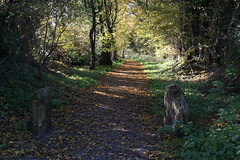
But out in the countryside, the vast majority of names seem to be functional.
My own theory is that before the gentleman from the Ordnance Survey arrived with his notebook the locals didn't really need to name the different paths through their village. Looking at the common names for a lane on OSM most are either based on an important building (Church Lane, Mill Lane, School Lane, Hall Lane, Rectory Lane,...), or they describe the lane itself (the list of examples like Green Lane, Long Lane, Sandy Lane, Marsh Lane, Water Lane, Broad Lane goes on, and on).
I imagine the surveyor turning up in the pub, putting down his top hat, and asking "what do you call that path, and what do you call that one?" and the ancestors of Eddie Grundy and his mates getting their heads together to think up some suitable names.
"Well that one's stony, and that one goes to the windmill, and the parson wouldn't be happy if we told him what we really call that one, so I suggest we tell him it's called Love Lane". "G'evening your lordship, I'm just telling old Amos here that we ought to name one of these paths after your lovely daughter Holly, who does so much for the poor folk of the parish. That would be very kind sir, I'll just have a pint please."
I've put a list here of the common names for a lane on OSM, ranked by the number of segments and total length.
Wednesday, 21 April 2010
Almost a big day today
I bunked off work early, and did a twenty-three mile loop out to Windsor and back before dinner. On the way I managed to find another blue plaque that I'd forgotten about. It commemorates Mariquita Tennant for saving fallen women.
Until just now I thought the best thing was that for the first time this year I was on track to reach my 2010 mileage goal. It turns out that the best thing must have been something else.
For complicated and unimportant reasons my goal is to cycle 3,759 miles this year. Today I passed 1,091 miles. Unfortunately I now realise that's only 29% of my target in 30% of the year. Not for the first time I'd made a mistake in a spreadsheet, and I'm still short of where I want to be.
Looking on the bright side, I'm just going to have to bunk off work early again tomorrow.
Until just now I thought the best thing was that for the first time this year I was on track to reach my 2010 mileage goal. It turns out that the best thing must have been something else.
For complicated and unimportant reasons my goal is to cycle 3,759 miles this year. Today I passed 1,091 miles. Unfortunately I now realise that's only 29% of my target in 30% of the year. Not for the first time I'd made a mistake in a spreadsheet, and I'm still short of where I want to be.
Looking on the bright side, I'm just going to have to bunk off work early again tomorrow.
Tuesday, 20 April 2010
Charles Knight
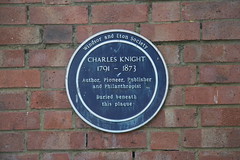
According to the local authority web site there is a plaque in Alexandra Gardens, near to the river. They even provide a map that shows where it is in the gardens, but despite several detours on recent rides to Windsor I've never been able to find it. Today I discovered it hiding about quarter of a mile away, at the other end of a footpath that leads to the gardens from Thames Street. I'm going to claim that I was looking in the right place but the plaque was elsewhere. I've added it to OSM and Open Plaques.
The other plaque that I've finally been able to track down and add (pictured) is in the Old Burial Ground at the end of Madeira Walk, next to Bachelor's Acre. It's pretty much where they said it was. If I'd not been looking in the wrong place I'd have found it on my first attempt.

Charles Knight was a publisher. Among other things he published the Windsor, Slough and Eton Express, and the Local Government Chronicle, both of which are still going today. He also published the "Library of Entertaining Knowledge", and the "Penny Cyclopaedia", which are both great titles, if nothing else. There are samples from the cyclopaedia here (it's got nothing to do with bicycles).
Sunday, 18 April 2010
Dear Mr Irritated

Like most cyclists I've encountered a small number of drivers who don't think I should be on the road at all, and a few who think cyclists are supposed to use cycle paths whenever they are provided, rather than the road. You are my first experience of a pedestrian who didn't think I should be on a shared-use path. Or at least the first who has told me what they were thinking.
The Highway Code is specific about how cyclists should use most facilities. We are not supposed to cycle on a pavement unless it is marked for shared use by cyclists. When it is marked for shared use then we are not obliged to use it. If we chose to use a shared pavement then we should allow plenty of room for pedestrians. We are urged to be particularly careful around children and the elderly. Even though you and your wife don’t fall into either category, I still ought to be considerate.
In other words, I had as much right as you to use the footpath, but I was under a greater obligation to be careful and considerate.
I assume you are not a cyclist. Some cyclists who ride on pavements are clearly idiots. I know some cyclists feel safer to be riding out of the way of traffic. However, my own experience is that with sufficient confidence in dealing with traffic the road generally feels safer than the pavement.
I almost always chose the road. Progress is quicker. There are fewer obstacles to avoid and fewer junctions to negotiate. Cycling on any footpath brings a constant fear that a car will shoot out or cut across unexpectedly. Vehicles on the road are bigger, faster, and more scary than pedestrians, but they are also more predictable. By the time you have taken sufficient care riding anywhere near a loose child on a footpath you might as well get off and walk. So normally the road is faster, safer, and on top of all that it often provides a more comfortable ride.
So yesterday I was on the shared footpath for a different reason. As you will remember, the footpath was just about wide enough for cycles and pedestrians to pass each other. More to the point, the road wasn't wide enough for a car to pass a bike without crossing into the approaching lane. You and your wife were the only people on the path (apart from me), but there was a steady stream of cars passing in both directions. Any cyclist on that road was forcing traffic to chose between following at the same pace, or waiting for a gap in the opposite carriageway to shoot past. In the previous section of that road there was no shared footpath, and I’d watched several cars making a dangerous manoeuvre to overtake me. I suspect the highway engineers knew what they were doing when they designated this particular shared footpath. It was my choice entirely, but my view was that riding on the shared footpath was no skin off my nose, and less inconvenient for cars.
So thank you for your question, and please pass on my thanks to your wife for stepping aside to make room. I wish I could claim that I always ride in the way that I should, but if I’m honest with myself, I can’t. You’ve made me think again about this occasion though. I never had any doubt that I was entitled to be riding where I was. On reflection, I still reckon it was the most appropriate and considerate choice for us all.
Subscribe to:
Posts (Atom)