Sunday, 14 September 2008

Roundabouts revisited again


disgruntled asked, on an earlier post, what answers the Cyclecraft book gave to the problems of negotiating multi-lane roundabouts. This is my attempt to summarise quite a rich mine of advice and suggestions. Before I start let me say that there are about four pages in the book on multi-lane roundabouts alone, and more than two hundred pages on different aspects of cycling: it is well worth studying the original source.

The first point I take from the book is that the best route for a cyclist to take round a multi-lane roundabout is much the same as a car would take: using the outer lane to turn left (we are in the UK); the centre lane to go straight ahead, and the inner lane to turn right.

The second point is that the main dangers to a rider on a multi-lane roundabout are when passing an entrance (because cars entering the roundabout may not see you); and when jockeying for position on the roundabout itself (because of the different speeds of cars and bike).

I think we had pretty much figured those out already, though I hadn't really taken on board the fact that, despite the problems of jockeying for position on the roundabout itself, you definitely do not want to be riding in the outside lane, when you pass an entrance with multiple lanes of cars joining the roundabout.

Reading on, the advice gets even more interesting.

In his book, John Franklin works through three different scenarios: for turning left, carrying straight on, and turning right. Much of the advice seems to centre on making sure that you maintain control of your lane. You do this, firstly by taking position early on approach to the roundabout: in the inner, middle, or outer lane depending on which direction you are going to head. If there are only two lanes on approach, then the best position for going ahead is the right hand (outer) edge of the left hand (inner) lane. Otherwise it is the centre of the middle lane. If turning left or right, then take up the centre position in the appropriate lane.

For me, some of this is counter-intuitive, but on reflection it makes good sense. The temptation is to make it easier for cars to pass, but in reality the best strategy is to make it clear that they shouldn't.

The same principle seems to apply to the advice on turning left: use the outer lane of the roundabout (left side), but keep well away from the kerb. The book specifies about 7 feet, or 2 metres, which sounds like almost the width of lane that a car needs - i.e. clearly enough to stop anyone passing in the same lane, and not enough for anyone to cut between you and the kerb.

For turning right, the advice is to use the outer edge of the inner lane around the roundabout: again seemingly with the intent of controlling the lane, without letting anyone overtake between you and the kerb. The book states the obvious when it says you need to signal clearly when starting to spiral out of the roundabout, but I imagine that by taking this position on the outside of the lane you are already indicating your next move to any following drivers.

Other pieces of advice include being ready to take evasive action, while not making any sudden changes of direction. Not to try and change gear while negotiating the roundabout (unless you have to drop speed suddenly), but to chose a gear beforehand that allows a relatively high speed, being ready to put on a spurt of speed if necessary.

He also describes some negotiation techniques to show drivers when you are determined to make a move (such as taking up a position on the edge of the lane you intend to enter, targeting a particular driver to make way for you, and engaging eye contact). Finally, he makes the point that on very busy roundabouts you can sometimes use other vehicles as a shield, particularly when they have made way for you to change lane.

In summary, the book doesn't pretend that this is easy, or that there is a single simple answer. I think we had already worked out that the best route for negotiating a complex roundabout on a bicycle was the same as the one that other vehicles use. At my current level of expertise, my new lessons are that I should show more clearly that I intend to maintain control of the lane, and I must resist the temptation to keep out of everyone's way by heading for the kerb. I could also do with practising techniques for negotiating with drivers for access to a lane, and in handling complex manouvres at speed. I don't really get how to use other vehicles as a shield, but I will leave this for another day.

Finally, thanks to everyone who has been joining in, particularly "disgruntled" who prompted me to try and set this down without losing any of John Franklin's clarity. I hope it makes some kind of sense.

Friday, 12 September 2008

Some timely advice

Yesterday on the way into town, I fumbled a junction, and forced someone in a yellow Renault to take avoiding action. On my way home, a bus driver failed to see me, or misjudged the distance, and pulled  out directly in front.

Neither event was particularly dramatic or dangerous, just the typical kind of mishap on the roads, that must happen millions of times a day. But I was annoyed at both: cross with myself for the first, and with the bus driver for the second.

So it's good timing for this quote from John Franklin's Cyclecraft, which I came across later in the day:

"If you have been aggravated by the actions of another road user, look for the earliest opportunity to have a good interaction with someone else, such as ceding way to a pedestrian or thanking a driver who had been helpful to you."

That strikes me as very sound advice, and a much more appropriate response than seeking some kind of revenge. I would like to think that the driver of the yellow Renault paid for my mistake with a small act of kindness,  and although it's a bit late now, I will look for some opportunity to do the same on behalf of the bus driver.

Thursday, 11 September 2008

Roundabouts revisited

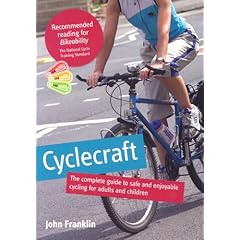
A couple of weeks ago Just Williams drew our attention to Cyclecraft by John Franklin. Yesterday I was in town to sort out some stuff, dropped into the bookshop and bought myself a copy, along with a book of local cycle routes.

Cyclecraft has no less than 16 clear and informative pages on how to negotiate a roundabout on a bike. The book describes the problems, and recommends plausible solutions. It nicely considers the issues from the perspective of both the cyclist and the car driver. I have already picked up on a couple of things that I could be doing better, and will no doubt discover more on further reading. 

The rest of the book looks to be of the same high standard, and my first impression is that Just Williams was spot on when he said that Cyclecraft "deserves to be read slowly and thoughtfully".

Yesterday evening I also explored one of the routes from my other new book (or at least a large part of it). It took me onto some unfamiliar roads, but the nights are starting to draw in, so a lot of it was in the dark. That rather detracted from the point of exploring new ground. However, it was a very satisfying stretch of 25 miles, including a number of roundabouts, all of which I negotiated safely and confidently (thanks, I admit on this occassion, to very light traffic rather than my study of Cyclecraft).

Monday, 8 September 2008

Sod's law proved wrong


Contrary to popular belief, working for myself, from home, is no panacea for achieving a sensible work-life balance. In theory it promises more flexible working hours, but in practice, 30 years of corporate habits are hard to throw off.

However, several days of crummy weather, and various domestic comings and goings meant that by this morning I hadn't been on the bike all week, and I was beginning to pace up and down like an animal in an old-fashioned zoo.

So this morning I decided to bunk off work for the day, and get out for a decent ride.

I headed over Winter Hill to Marlow, then up into Buckinghamshire.

The first few miles were the same route that I use to race Walter Y'Geaux, my alter ego, on the GPS; and it was a pleasant change to take it a bit more slowly. Then I negotiated Marlow, and started the long climb up to Frieth. The first part, to Marlow Common is quite challenging and I was puffing and panting a bit, but quite pleased to be keeping up a decent pace, until a gentleman, who must have been at least ten years older than me, passed at about twice the speed, with a cheery "good morning", and little sign of effort. You can't get too complacent on a bike.

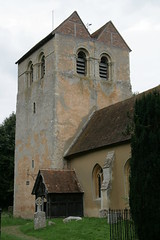
From Frieth I made my way to Fingest, which is mostly downhill. I stopped to look at the church, which has an impressive 12th century tower. Apparently there is only one bell, although there is space for a whole peal. According to the leaflet in the church, local tradition holds that a previous rector lost the rest of the peal in a bet with a neighbouring parish.

After Fingest, I went on to Turville. For anyone who doesn't know, this is all very pleasant countryside, and Turville was the location used for recording the Vicar of Dibley. Then I headed south again, towards Hambleden to join the main road back to Marlow and then home.

After last week's puncture, I had made a special trip to the bike shop to stock up on patches and a new inner tube. Sod's law dictates that if I hadn't done this, then without the means to repair it, a puncture would have been almost inevitable; and because I was well prepared another puncture was highly unlikely.

Well Sod is wrong.

Just after Turville the back tyre went again; and out came the new repair kit. While I was fixing it, another cyclist stoppped to check that I had everything I needed, which was nice of him, but I'm beginning to get quite practiced at this now. Somebody is bound to ask the question I asked myself - "did you make sure the nail wasn't left in the tyre?". And the answer is, yes, and the new hole was in a different place - it was definitely a different nail this time.

All in all, though, it was a lovely day for bunking off, and a very pleasant outing. The weather was mostly overcast, veering between "almost raining" to "almost sunshine". In all I covered just over 40 miles, which isn't too shabby, and logged a few minor roads that haven't appeared on Open Street Map yet. There were also a number of signs for local cycle routes that I don't remember seeing before, so there is a decent excuse for going back to do some more exploring.

Tomorrow, though, I will have to do some real work.

Sunday, 7 September 2008

It's PC gone mad


Phone hoaxer claims he's Inspector Morse's sidekick

A man claiming to be Inspector Morse's sidekick Lewis has made a slew of hoax phone calls to local addresses.

Over the weekend police received nine reports relating to suspicious telephone calls in the Dedworth and Old Windsor area.

A police spokesman said: "In all cases the call was made by a man, who claims to be DCI Lewis, of Morse fame, from Thames Valley Police. He claims there is trouble with youths in the area and he would be grateful if the call recipient could assist him by looking out of an upstairs window, to see if there is any youth activity in that area."

I suppose it's not funny really, but I couldn't resist the headline. And for what it's worth, this article from the Maidenhead Advertiser is captured from the new Google "Chrome" browser - which I installed this evening: it looks pretty good.

Friday, 5 September 2008

Wordle


Crummy weather means no outings on the bike, and hence nothing out there in the real world to post about.


So instead, here is a cloud from Wordle, based on earlier content. With thanks to Town Mouse for the pointer, and for a much better sample.


Tuesday, 2 September 2008

Sometimes you just can't see the wood for the trees


Open Street Map, and its spin-offs are not the only mapping initiatives that are using volunteers to put mapping data into the public domain. The woodland trust is running an Ancient Tree Hunt which aims to "find and map all the old, fat trees across the UK".

Their interactive map is here, they have forms where you can record an ancient tree, and submit it for verification and adding to the map.

It looks as though there are a heck of a lot of ancient trees out there that need a hug.