Wednesday, 13 October 2010

Six good reasons to abolish Cycling England

#1 Abolishing Cycling England will help to reduce public spending
  • Cycling England spends £60,000,000 p.a., Abolishing it would save money, and only leaves another £127,940,000,000 to find from the annual saving of £128,000,000,000 that the treasury is looking for
  • Saving public money takes time. To placate the markets, and save on interest charges the treasury wants to reach that level of annual savings by 2015-16. That's about 5 years away. Cycling England has only a small staff, and most of the spending goes on projects, so it should be possible to make the savings quickly. Making a quick saving of 0.047% of the total should accelerate the date when the books balance. 0.047% of five years is about 18 hours - almost a whole day
#2 Abolishing Cycling England will help to improve tax revenues
  • The treasury raises virtually nothing from taxing cyclists (a bit of VAT on bicycles and accessories, which they would get whatever the money was spent on). But from car drivers they raise about £5.7bn a year in Vehicle Excise Duty, and £24bn in Fuel Duty, plus bits and bobs on congestion charge, tolls, and so on. They spend about half the total on maintaining the road network    
#3 Abolishing Cycling England will help with economic recovery
  • Each additional cyclists takes about £150 a year out of the economy, mostly in savings to the NHS, reduced cost of congestion, and reduced cost of pollution
  • As it costs about £15bn a year to maintain the road network, it  makes sense to make the maximum use of that huge investment
#4 Abolishing Cycling England will help to reduce welfare dependency
  • Cycling improves productivity at work, and extends life - the last thing we need at a time of high unemployment, when the priority is to reduce the numbers of claimants, and control the cost of state pensions
#5 Top nation status
  • The UK leads Europe in the proportion of the population that is obese or overweight, but at 61% of the population we have only a slender lead over Germany (ranking in second place at 60% of the population). There is a clear risk that we lose top place in these rankings if too many people exercise
#6 Cycling England has already achieved its goals, and its work is therefore complete
  • The Conservative Manifesto committed to "give the concerns of cyclists higher priority"; the Liberal Democrat manifesto committed to "facilitate an increase in levels of cycling and walking, through investment, information and innovation; use local transport planning to promote the adoption of sustainable transport methods, including cycling...; ensure that there is an obligation on developers to plan for the provision of ... walking and cycling facilities; promote an expansion of the National Cycle Network, particularly off-road routes; on-road cycling will be made easier, safer and more accessible to all; promote cycling competency schemes and encourage better facilities for cyclists; introduce a cycling ‘Gold Standard’ award for all rail and bus stations meeting minimum cycle facility standards, including adequate provision of secure cycle parking and information on local cycle routes; support the adoption of large scale bicycle rental programmes; ensure that road traffic law is enforced with equal vigour in relation to cyclists; the coalition agreement commits to support sustainable travel initiatives, including the promotion of cycling. With that level of commitment in place, there can be no further need for an independent body tasked with promoting cycling

Sunday, 10 October 2010

Back in the saddle


Six days after the bump, today I decided to get back on a bike. I couldn't ride the normal bike, because it's in the shop getting fixed. So I got the hybrid off the rack, pumped up the tyres, and took it for its first outing in months.

I set off with a bit of trepidation. Partly because I wasn't sure which bits were still hurting, but more about how I would react to traffic after being walloped by a car.

So I picked a nice quiet route, away from the main roads. One that I used ride regularly when I first got back into cycling. It winds around a mix of different suburbs for about five miles.

In the event all was fine. I'm a little bit more wary of traffic than I was, but maybe that isn't such a bad thing.

And I can honestly say that I was pedalling like a steam engine. With a tender behind.

Tuesday, 5 October 2010

Spending on bikes in Europe

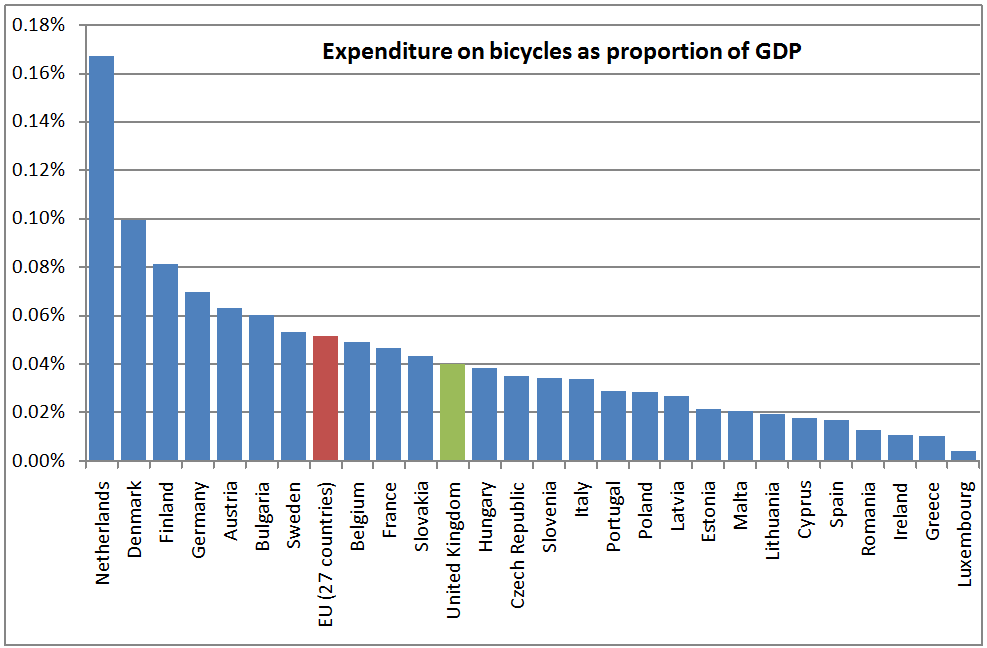
Bike Europe and Colibi provide various statistics on bicycle sales across Europe. I've combined their numbers with some Eurostat figures on population and GDP, to investigate differences between the countries we have been visiting over the last couple of weeks.

In proportion to the size of the economy, the Netherlands spends more than anyone else on bicycles. We in the UK spend less than the European average. We didn't visit Italy, but I imagine that the cycling culture is similar to France. In that light, their expenditure on bicycles seems surprisingly low.


Part of the reason that the Netherlands spends so much is that they buy expensive bicycles. The average price of a bicycle in Germany is fairly high. In Italy it is close to the European average, but we in the UK tend to buy cheap bikes.


We in the UK do buy quite a lot of bikes though. More than the European average, and about the same as Germany and France. But not as many as in Denmark or the Netherlands. The Netherlands spends most because they buy lot of bikes, and spend a lot on them. While Italy buys bikes at close to the average European price, they do not buy many of them. In France they pay less than average for a bike, but buy a lot of them. In Germany they buy quite a lot of fairly expensive bikes. In Poland, as in most "new" EU member states, they buy quite small numbers of relatively inexpensive bikes.


Challenging the natural order

I've been reading "Need for the bike" by Paul Fournel, following coverage on the Bike Show on Resonance FM.

I see that the Library of Congress classifies this as "cycling - anecdotes". In a way that's true, but it hardly does justice to the contents. It's a remarkable little book, in which Mr Fournel meditates on various aspects of cycling. Some of it goes way over my head, but there are plenty of nuggets that provide new insights into things that I have noticed myself (or things that I now see that I should have noticed).
                    
At one point Fournel realises that he has always mounted his bike from the left, putting his right leg over first. He decides in future to alternate from one side to the other. I too have always mounted my bike from the left (I have at least one thing in common with Mr Fournel), and pushed off with my right foot.

Yesterday evening I decided it was time for a change, so I gingerly mounted from the right, and pushed off with my left foot.  It was all a bit strange. I suppose that means I should do it more often.

Soon I was off riding one of my normal circuits, but in the same contrarian spirit, I followed it in a counter-clockwise direction - the opposite way round to my usual habit.  Two miles out, the bike was clipped by a car at a difficult junction and I was thrown into the road. My short experiment was at an end.

I was pretty shaken, and a bit battered, but the poor bike suffered more. The pannier rack is badly bent, and the back wheel is out of kilter. I'm not sure whether the frame is damaged, so I will need to take expert advice on that. At minimum there is some repair work to be done. I hope that's all.

Everyone, including the driver directly involved, was very considerate and helpful. I was able to walk the two miles home. I had a hot bath, a stiff drink, and a good rest. This morning, I have acquired a few aches, bruises and scars, but I don't seem to have suffered any lasting damage.

If I was superstitious I could put all this down to my attempts to disrupt the natural order of the universe. But I'm not superstitious - it was an accident, and sometimes accidents happen. It could probably  have been avoided, but it could also have been a lot worse. Thankfully life goes on. I suspect the aches and pains will too, for a while.

Sunday, 3 October 2010

A Journey

The bike has spent the last couple of weeks in the shed while we travelled almost 3,000 miles across Europe. We visited six different countries, but spent most time in parts of Poland, Germany and France. It's been a few years since we did anything like this, and it was a fascinating trip. 

In the process we saw a of different cycling infrastructure, and a variety of bikes and cyclists. However I've been viewing it all from inside the car or as a pedestrian, rather than from the saddle. Of course we only sampled tiny parts of huge countries.  

One of the surprises was in Poland. To put it mildly, the transport infrastructure in Poland is a bit varied. The new motorways are among the best we travelled on, and we saw a lot of other construction under way, but elsewhere heavy Trans-European traffic has been causing a lot of damage to some relatively minor roads. Hours of bumping along some very ropey surfaces have given me a different perspective on the standard of UK roads, and I won't be complaining about potholes and patchy repairs in Berkshire (for  a while anyway). 

What surprised me was that alongside some of the rougher Polish roads they were busy laying miles of beautiful new cycle lanes. At first glance this seemed an odd priority. We spent some time in Gdansk, which has taken a lead as a cycling city, and I understand that in Eastern Poland there are moves to encourage cycle touring as a contribution to economic development. We were mainly in central and western Poland though, and I suspect that the rationale for investing in cycling infrastructure there is more to do with improving road safety and access for scattered communities rather than either promoting tourism, or encouraging environmentally sustainable transport.

In Germany, by contrast, the quality of the transport infrastructure is notoriously good, and it was no surprise to find an extensive cycle network in the towns and region where we spent most time. Here the investment seems to be much more oriented towards encouraging utility cycling in the towns, and tourism in the rural areas - and in both cases the facilities were being well used.

By contrast, the evidence for the famous French passion for cycling was mostly in the wide choice of cycling magazines in the racks. We didn't visit the most famous cycling areas, but investment in cycling infrastructure in the places we visited was mostly limited to painting lines and symbols onto footpaths. As a temporary pedestrian, it wasn't  particularly helpful.  

For better or worse, the stereotypes that I'm left with are that cycling in Poland is mostly utilitarian. A wide range of different people apparently ride basic hybrid bikes, mainly as a convenient form of transport.  In Germany what we observed was mostly cycling as a pastime. Most cyclists were middle-aged, and leisurely riding extremely well-equipped trekking bikes, along relatively flat dedicated cycle routes. Whatever French cyclists are doing, they are doing it somewhere else. In the areas we visited keen cyclists must mostly spend their time reading magazines that cover cycling as a sport.

I'm left wondering what superficial impressions a visitor from abroad would form of cycling in the Thames valley.

Saturday, 18 September 2010

Inner tail wind

The entire Wikipedia entry for Shurlock Row reads "Shurlock Row is a village in Berkshire, England, and part of the civil parish of Waltham St Lawrence. The settlement lies north of the M4 motorway, and is located approximately 5.5 miles (8.9 km) south-west Maidenhead."

So it's not a destination packed with excitement. It's a pretty village, a fairly short ride from home. It has a pond, and a pub, but if there's anything at all notable that I would pick out, its the pleasant mix of houses from different periods. I think of them as Shurlock homes.

Shurlock Row was where I headed this morning, via a circuitous route, on a quick spin before our visitors arrive.

Sometimes the roads in these parts can get busy, but they were fairly quiet this morning. There were a number of cyclists about, and  quite a lot of walkers, including a party of mature ramblers that I passed on one of the quieter lanes. They seemed to be equipped for mountaineering in the Alps.  That's not an uncommon sight around here, and I suppose it is the pedestrian equivalent of MAMILs* on expensive road bikes. Perhaps we should expect to see the emergence of a "real rambling" movement as some kind of backlash.

All that apart, the best thing about this morning's ride was that it was such a lovely, sunny, crisp early autumn day. There was a little bit of a breeze, but that was easily overcome by my inner tail wind, which drove me and the bike along briskly for an unremarkable, but very satisfying outing on a glorious morning.

*MAMIL="middle-aged man in lycra"

I've just discovered the old web site of Shurlock Row Garage in "maintenance mode" - how appropriate. Their real site is here.

Friday, 17 September 2010

The Church of Sit-Up Cycling

Everyone should know of the The Church of Sit-Up Cycling, which was established as a response to a Vancouver law which makes it illegal to ride without a helmet "unless the wearing would interfere with an essential religious practice". Thanks to CTC for the link.

The Church "requires its adherents to cycle for work and play wearing whatever they want (and) the freedom to choose headwear - which may or may not include plastic - is an essential religious practice."

According to their web site, they also hold that "children should do what they're told until they get a job and start chipping in with the rent". Personally, I think that children should do what they're told, full-stop. I never did, and I expect the next generation to re-align the universe. But as the family are getting together this weekend, that's a view that I should probably keep to myself. There's quite enough controversy around cycling helmets, without getting into inter-generational arguments.