Saturday, 31 July 2010

July round-up

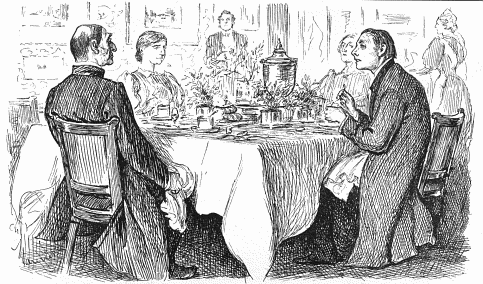
The bishop says, "I'm afraid you've got a bad egg, Mr Jones."
The curate replies, "Oh, no, my Lord, I assure you that parts of it are excellent!"
From Punch, 9 November 1895 
That's a bit how this month has turned out.

My total mileage continues to slide gently behind the plan that is going to get me to a total of 3,759 miles by the end of the year. I've made little progress on the subsidiary goals around Eddington numbers, Jenkins churches and the like.

On the other hand, I've been reminded that I don't just trundle around on the bike trying to accumulate numbers for the spreadsheet. It's been a good month to remember that the real satisfaction is in the ride itself. There's little to beat the sensation of spinning along a country road, with plenty of energy in reserve, feeling in touch with what is going on around. In July I've had more than a fair share of rides like that.

I've also met a number of people who are enjoying a variety of different kinds of cycling. Some of them just find it a convenient way of getting around. Some are cycling because it's a way of having fun with their children or their friends. Some are finding that it's an enjoyable way of exploring parts of the world that they know little about. All of those are important to me too.

What's more, the distances are turning out to be a bit of a two-edged sword. A few days ago I mentioned to a colleague that I might ride 20 miles or so to drop some papers off. A few weeks ago I rode 40 miles or so to visit friends in Oxford. On both occasions the reaction suggested that these were hugely impressive athletic achievements. On the face of it that seems flattering - but on reflection it isn't. The truth is that they aren't impressive distances - unless you add the phrase "...for someone of your age". And thinking like that is a bit dispiriting.

It's far easier for me to record the quantities, rather than the qualities. That's why I tend to rabbit on about numbers of rides, distances covered, and so on. In truth it's the quality that matters more. In different ways the last month has turned out to be a good reminder of that.

(I think that's a plausible enough excuse for now. I'm going to have to start racking  up the mileage soon though, or the spreadsheets will start to look really sick).

Thursday, 29 July 2010

National travel survey

The Department for Transport has released a heap of cycling statistics from the National Travel Survey here.

On average in 2009, people made 16 journeys by bicycle, out of a total of 973 journeys (i.e. 1.6% of journeys were on a bike). The average distance travelled by bicycle was 46 miles over the year, or 2.9 miles per trip. Over recent years the number of trips has been steady, but distances increasing. 14% of people say they ride a bicycle at least once a week and a further 9% said they do so at least once a month.

Men in their late teens and forties make the most cycling trips. Men in their forties are more likely than other adults to own a bicycle, and they ride the longest distances (or at least they claim to).

37% of cyclists mainly ride on the roads, 31% mainly on cycle paths, and 21% mainly off-road (the rest on a mixture of all three). Commuting, leisure and other reasons each account for around a third of cycle trips, and the months of March-October account for three-quarters of all cycle trips.

I'm left surprised at how many people own bikes (about a third of adults), yet how little they ride them. It's not so much the number of rides. As far as I can figure out, people who own bikes must be riding them about once a week on average, more in summer, less in winter - which sounds plausible. But an average trip of less than three miles means that an awful lot of rides must be over within a matter of minutes.

Wednesday, 28 July 2010

Roundabout samaritans


View Larger Map

This is the roundabout at the end of Maidenhead bridge. Several of my regular rides bring me back to here, heading northwards along Sustrans regional route 52.

The conventional approach is along Guards Club Road, the small road joining the roundabout from the south. To the left and right is the A4, which is almost always busy. Ahead is Ray Mead Road (the A4094) which isn't quite so busy, but at certain times of the day it will also have a queue waiting to join the roundabout.

Following the cycle route northwards involves crossing the A4 and continuing along Ray Mead Road beside the river. One option would be to dismount and walk the bike across the A4. There is a pedestrian island to help, but doing that seems a bit wimpy, and I'd much rather keep riding.

The trouble is that there is usually a steady stream of traffic entering and leaving the roundabout from the three busier roads. Joining from a minor road can involve quite a long wait, and it is very rare for a car driver to give way and let me out on the bike.

However, I've discovered that I can also nip through the hotel car park on the right. That means that I join the A4 just a few yards before it joins the roundabout. If I do that, I find that almost immediately a driver will drop back, leaving a gap for me to join the main road, and wave me out. It happens almost every time. While it won't necessarily be the first car that lets me out, it's usually within the first three or four.

At the roundabout drivers are conforming to the stereotype of not giving any quarter, but just a few feet away they behave quite differently. I have no idea why this works, but each time it saves me a frustrating wait at the roundabout. More importantly, each time it happens is like being given a little treat. Whatever the reason, it's a small pleasure on the ride that I've started to look forward to whenever I ride this way.

Thursday, 22 July 2010

Tuesday, 20 July 2010

Saddle


Back in March I treated myself to a Brooks saddle on the new bike. I was told that they were very comfortable, I like the look of them, and I was intrigued to see how it would differ.

There is a considerable amount of advice around on how to treat a leather saddle. Not all of it is consistent. This is my experience.

Even before sitting on it, the first impression was that it was very hard. You can knock on it, like a piece of wood. Sitting on it did not feel uncomfortable, though. The big difference on the first ride was that it seemed very slippy. It no longer feels slippy, but I'm not sure whether that is because I've got used to it, or that things have changed.

I didn't experience any discomfort on the first, short ride. After longer rides, though, it was certainly easy to identify the position of my "contact points".

I trusted the advice that the saddle would gradually adjust shape to fit my posterior, and that does seem to be the case. It took about 500 miles before I felt it had become really comfortable. That seems to be about the normal experience. I've now ridden about 1,600 miles on it, and if anything it just keeps getting better. Visibly the shape has hardly changed - just some slight indentations - but it feels different.

I did nothing to try and soften the leather, or accelerate the re-shaping process (other than riding on it). I have applied Proofide to protect it from the wet, and I expect to apply more occasionally. Underneath I have tried to get a lot of Proofide to soak in, by warming both the tin and the saddle. On the top I have used it sparingly. I also keep a little waterproof cover in the saddle bag in case I need to keep the rain off.

My overall impression is that it is very comfortable, and has been since the first 500 miles or so. I believe those who say that it will only get better over time. However, the level of comfort is very dependent on the saddle being at the right angle and right position. So it takes some fiddling to get the configuration just right.

It is a bit heavy, but that isn't a big issue with my kind of riding. I'm not sure how important this is, but I do take care to keep the rain off. And I've discovered that it is not a good idea to ride in light trousers.

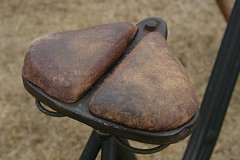
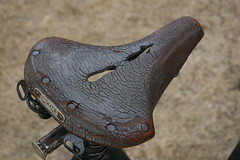
I'm pleased with it. The saddle in the picture is not mine, which is a black B17 narrow. I suspect I will end up looking like the picture before my saddle does. With reasonable care, I imagine that my saddle will last longer than I do.

Monday, 19 July 2010

Images on a map

It's been done before, and to be honest it has been done better, but still it's nice to see the National Archives allowing us to search historical images on a map. They have started with a collection of 14,000 photographs from the 1920s-1940s, and promise more.

It's an interesting start, and fun to browse. I've voted for "quite useful" on their survey page, which is a bit less enthusiastic than most others. The specific feedback shows that some people seem to be having browser problems, but it works fine for me. My reservations are that it would be nice to see more precise locations, a bit more information the individual pictures, and a way to mix text and location searches. Perhaps all that will come (via crowdsourcing?), and meanwhile it is definitely worth taking a look. The link is here.

Sunday, 18 July 2010

Non-stop braking system


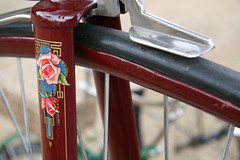
This is the "spoon brake" on a beautifully restored penny-farthing bicycle that was on show this weekend at the Thames Traditional Boat Rally. I believe I have the Solent Veteran Cycle Club to thank for an interesting display.

A spoon brake is a bit like a spoon connected to levers, that are used to press it against the solid tyre. It isn't obvious from the picture but this type of brake on a penny farthing is working on a wheel that might be as much as five foot across. The bigger the wheel, the higher the speed that a strong rider could achieve. Speeds of more than 20 miles an hour were recorded over short distances, and the best riders could sustain 18 mph over distances of 50 miles.

At those speeds the inevitable question is how they would slow down.

There was no free-wheel, so to some extent the rider of a penny farthing must have been able to use the fixed pedals to control their speed. Even with that assistance, I find it hard to believe that brakes like this were very effective. Indeed, somebody pointed out to me yesterday that an effective brake on such a large wheel would just pitch the rider over the handlebars anyway.

"Taking a header" or "coming a cropper" was common, and could result in serious injury or even death. Apparently the term "coming a cropper" was lifted from horse-riding where it meant being thrown over the horses neck. In 1874 The Pictorial World reported "in truth bicycling is rather a dangerous amusement, but then it affords such excellent exercise". Indeed.

To reduce the risk riders would hook their legs over the handlebars when they were travelling downhill. Without helmets, the advantage was that if they were pitched over the handlebars they would be able to land on their feet rather than their head. The disadvantage (presumably) was that with their feet over the handlebars they couldn't use the pedals to slow their speed. So it was all down to the spoon brake.

In its heyday, what we know as a "penny-farthing" was just called a "bicycle". As better designs began to emerge, it became known as an "ordinary" bicycle. When designs much like today's diamond frame began to  supersede the penny-farthing they were known as "safety" bicycles. That makes more sense to me now.